


Susan Ewing
Susan is the author of Ten Rowdy Ravens, illustrated by Ketchikan artist Evon Zerbetz
The little girl gripped the edge of the folding table.
“Billy is not afraid,” she told me with a steely look as her brother handed over Billy for the slug race weigh-in.
I peeled the surprisingly sticky Billy from my latex-gloved hand and laid him on the digital kitchen scale. Ten grams. A small contender but feisty, judging by his boldly waving eyestalks. Behind the girl and her brother the line stretched out: young handlers clutching a motley assortment of plastic containers bearing challengers for Ketchikan, Alaska’s Blueberry Festival Slug Race.
A slug race is by definition a foot race. Like snails, slugs are gastropods, a name derived from the Latin for “stomach foot,” to describe their stomach-riding-on-a-foot body plan. A slug race is also by definition slow, but not nearly as slow as you might think.
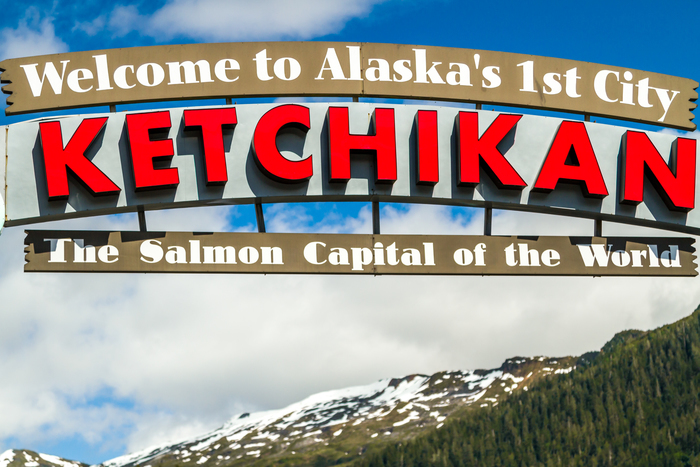
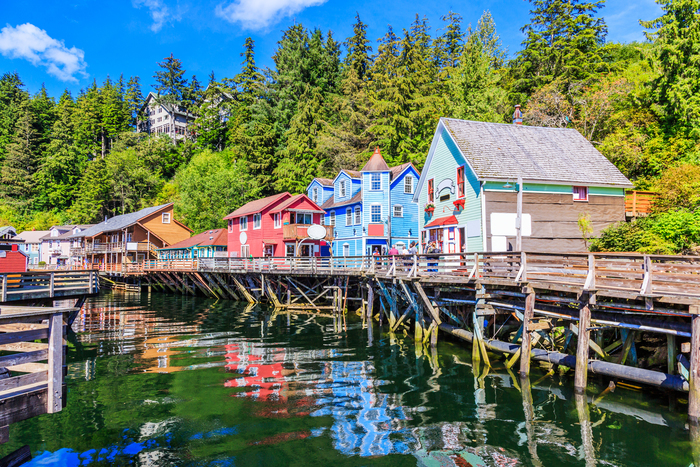
I was in Ketchikan visiting friends and volunteered for the slug race as a lark. The event was being held in the Methodist Church parking lot, which was cut into—as nearly everything in Ketchikan is cut into—the steep hillside sweeping back from Tongass Narrows. Tongass Narrows is part of Alaska’s famous Inside Passage, traveled by whales and cruise ships and incessantly abuzz with float planes. Ketchikan’s cool, wet maritime climate makes it a slug haven.
With Billy safely back in his lettuce-lined container my fellow volunteer and I weighed the next entrants, collected by their handlers from Ketchikan’s woods, cemeteries, gardens, yards, and public boat ramps. Turbo, 20 grams. Black Shadow, 14 grams. Sluggy, 1 gram. Leaf—46 grams! A cheer went up as Leaf’s impressive weight was recorded on the flip chart.
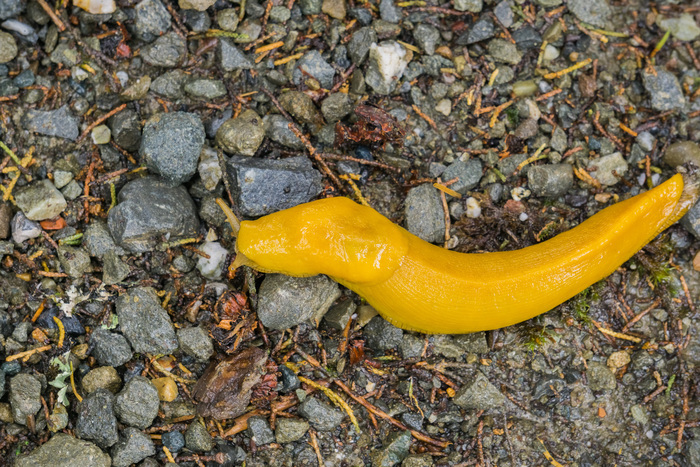
Leaf was a credit to his species, Ariolimax columbianus, the banana slug. Native to the Pacific Northwest and Alaska, Ariolimax comes in a range of colors from lemon yellow to brown, sometimes marked by sporty camo patches. The majority of the day’s racers appeared to be Ariolimax, with a contingent of the nonnative black slug, Arion ater, thought to have smuggled itself into Alaska in nursery plants, potting soil, and wooden pallets. You’re likely to find Arion chomping chard in the garden, but look for Ariolimax in the woods, doing its heroic duty for ecosystem health by eating dead and dying vegetation, animal dung, carrion, and fungi, to excrete as nitrogen-rich humus.
After 40 hectic minutes we had checked in 45 slugs. Twenty minutes to go until race time.
“So, how does the slug race work?” I asked. Cindy looked at Kirsten looked at Layla. The woman who had managed the race for over 20 years recently stepped down to make room for new blood. Some of that new blood sprinted off to find out how it was done.
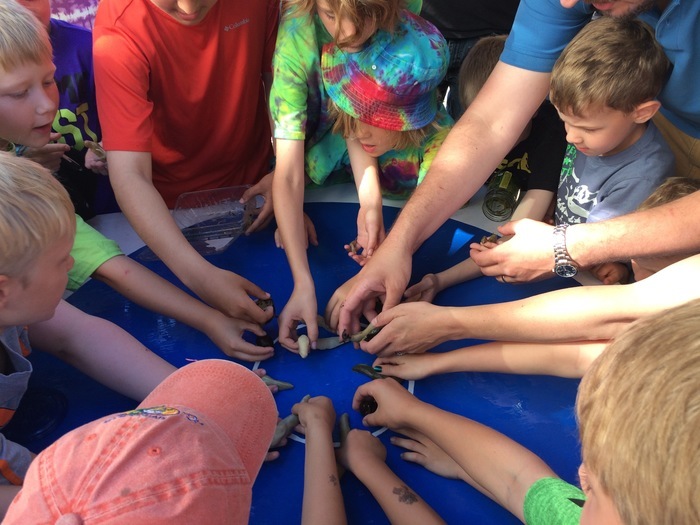
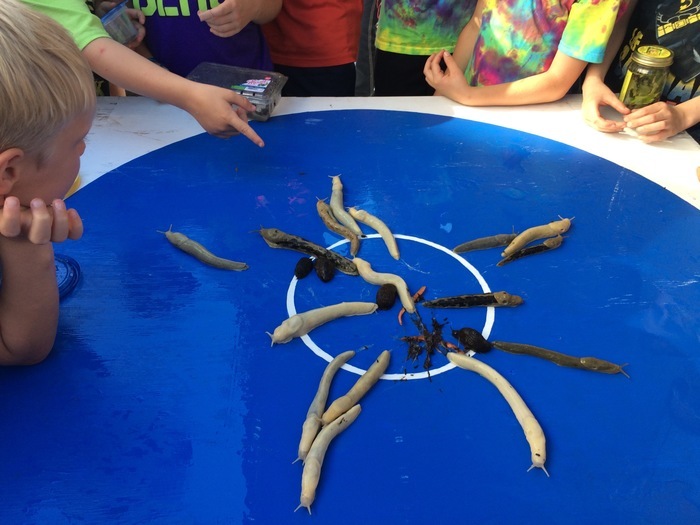
Meanwhile, the growing crowd milled around three tables, each holding a 4-foot-square plywood race board. The boards were painted with a solid blue circle that went almost to the edge of the board, with a smaller circle about the size of a dinner plate outlined in the center.
A breathless volunteer came back with the loose details: three races are held simultaneously as an elimination round, and the first place winners of those races face off in a championship round. For the elimination round, handlers randomly divide themselves up around the three race boards, hold their slugs out over the middle of the board, and put them down in the middle when the race master says go. It’s imprecise and something of a free-for-all, but this is Alaska and that’s the way they like it. Whichever slug reaches the edge of the big blue circle first, wins. The championship race follows the same protocol.
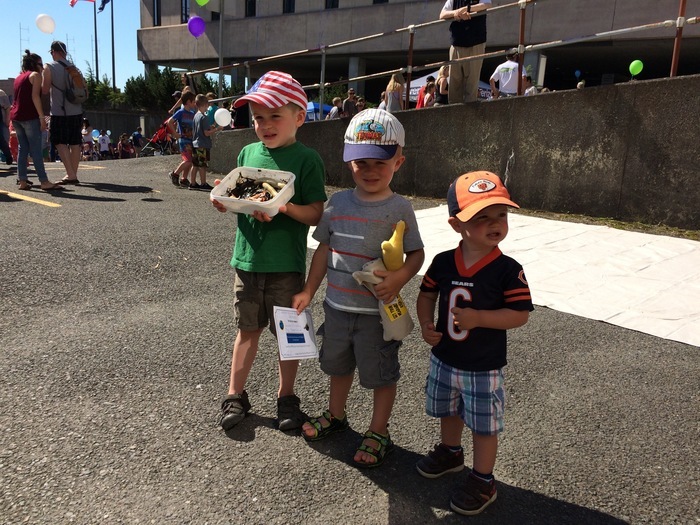
Handlers and their families packed in around the boards, while overflow spectators eating cotton candy settled into portable metal bleachers. It was one of Ketchikan’s first sunny days all summer and people were feeling festive as sunburns bloomed.
Kirsten took the mic. “Are you ready racers?”
The crowd roared its affirmation.
“… get set, go!”
Handlers dropped their slugs, and they were off.
Kirsten, in her first spin as race emcee, had come prepared with interesting slug facts to fill what one would reasonably expect to be a long, dull stretch of time.
“Did you know,” she said through the sound system, “slugs live for one to six years?”
Woohooo—GO Maverick! MOVE IT MOJO!
Kirsten raised her voice. “Slugs eat with a rasp-like radula, made up of thousands of tiny, razor sharp teeth.”
SLIMY! HERSHEY! GO GO GO!!
“They also use their radulas in slug-to-slug combat!” Kirsten shouted into the mic. At least that’s the kind of thing I think she was saying, because the raucous crowd of 12-and-under handlers and their familial pep squads drowned her out as they shook their fists and waved their hands over the board, urging on their racers.
In the race I was watching, most of the Arion black slugs curled up and sat tight while the Ariolimax banana slugs fanned out toward the perimeter, pneumostomes flaring. The pneumostome is like a whale blow hole and opens to the slug’s lung-like respiratory cavity, gulping in air when the slug is laboring and needs more than it can breathe through its skin.
Who knows why most of the slugs stretched themselves out so deliberately toward the edge of the board? Slugs can’t see, exactly. Their two eyestalks give them a terrific joie de vivre, but the little bulbs at the ends of the hollow, telescoping rods hold only a rudimentary retina that looks like a poppy seed stuck in there. The two lower sensory stalks, closer to the mouth, collect information on smell and taste, so maybe the racers were smelling their way back to their handlers and the safety of their containers, which were variously supplied with blueberries, tiny garden strawberries, fresh greens, and mushrooms.
You can do it Snowflake!
Speedy!! Dad—why isn’t Speedy moving?
Charlieeeeeee!
Every handler knew his or her slug as surely as a penguin knows its own chick.
As they say in the slug racing world, the frontrunners were laying down some serious slime. A “pedal” gland located on the bottom of the slug’s muscular foot produces a silvery trail of relatively thin and slightly elastic slime, or mucus to use the clinical term, that the slug travels on. Additional “goblet” cells located all over the slug’s body produce yet more slime of varying consistencies for auxiliary functions like defense against predators, moisture retention, communication with other slugs, and reproduction (slug sex is worthy of its own story, believe you me). When released from the slug’s body, a molecule of slime can quickly absorb 100 times its volume in water from the surrounding environment. That’s why washing slug slime off your hands with water is a lost cause. Better to wipe the slime off with a dry towel or rub your hands together and roll it into a ball like you do with rubber cement.
Here’s one for you: slug slime is a non-Newtonian fluid. It can behave as either a lubricant or an adhesive, based on applied force. That’s the key to slug locomotion. Fluids that obey Isaac Newton’s law of viscosity, such as water, mineral oil, and alcohol, don’t get thicker or thinner under shear force. (Shear force occurs when you push a block across a table, as opposed to compression force when you push down on it.) But the properties of non-Newtonian substances, which include silly putty, ketchup, quicksand, oobleck, non-drip paint, and slug slime, do change with force. Slugs travel through life in a brilliant collaboration between muscle contraction and slime. Muscle contractions send rippling rhythmic waves across the surface of the foot. Each wave is about a millimeter from crest to trough, and the waves travel at a couple of millimeters per second. The slime under these ruffling waves shifts from sticky to slippery depending on the shear force of the wave as it passes. As shear force is applied, the slime goes thins and slippery. As force is removed, the slime thickens and becomes adhesive. So it’s push-off slide-up, ratcheting forward a millimeter at a time. When the slug stops its forward motion, it can stick in place even on vertical surface.
Slug slime’s extraordinary properties have recently thrust the miracle goo into the scientific spotlight. Using slug slime as their starting point, researchers developed a new family of experimental adhesives for surgery and wound treatment that are strong, elastic, nontoxic, and will bond to wet surfaces like a bloody, beating pig heart.
SLUG-O! SLUG-O! SLUG-O!
The crowd hit a fever pitch. Whitey was drawing close to the finish line, giving it his-and-her all. Slugs are hermaphroditic, equipped with full male and female reproductive systems. Yes, they employ every component part during an elaborate copulation, assuring mutual fertilization. Slugs can even self-inseminate in hard times.
Whitey telescoped an eyestalk over the line to capture a win and the fans went berserk. On the other boards, Racer and Fastest Winner won their rounds. The crowd was jubilant, mostly. We don’t cry at slug races, one mom gently reminded a disappointed handler.
The first race was over in three minutes and the entire elimination round was wrapped up in six minutes. Top speed was about six inches per minute, which included time to stop and wave some eyestalk at the fans.
The throng boisterously and expectantly reconfigured around one board for the big finale. Whitey, Racer, and Fastest Winner—all the same pale mushroom color and six or more inches long—were held over the board.
Go! Said Kirsten.
The three slugs dropped into the ring and…sat there. One slug retracted all four sensory tentacles, pulled itself in a bit, and took on the posture of a sleeping dog.
Slug wranglers misted the slugs and board with spray bottles. The clock ticked. Children got agitated. “Like, 25 million years later,” one boy complained loudly. It had been four minutes. Wranglers misted again. Spectators began to drift away.
“Closest slug to the middle circle should win!” shouted a boy whose slug might have been closest to the middle circle.
Festival organizers needed to get on with the pie eating contest, so the championship round was called after eight minutes and an official brought out a measuring tape. Racer, an eighth of an inch shy of breaking out of the inner circle, was declared the winner. Whitey, a quarter of an inch away, took second. The third place slug, Fastest Winner, appeared to be deceased. But he/she could have been merely resting; slug resurrection stories abound. The winning handlers collected their certificates and Blueberry Festival t-shirts, and with that, it was almost over.
The only hard-and-fast race rule for the great Ketchikan slug race is that handlers must return their slugs to the wild after the event. But of course they do.
“Bella is a very good slug,” a little handler told me as her family put their defeated competitor back in her/his box.
Slimy gastropods may not have the charisma of Alaska’s whales or bears, but those big native banana slugs are deeply interesting and beautiful creatures once you get to know them. Slugs are like the coworker or neighbor you find so weird and unattractive until you take the time to get acquainted and discover how crazy interesting they are. What luck it is to be in Ketchikan on a sunny day, on such a peculiar, exceptional planet.
Would your family love to travel to Alaska this summer to attend the Blueberry Festival in Ketchikan? Off the Beaten Path can suggest all kinds of alternatives to giant cruise ships for touring Southeast Alaska – and fun “local” ways to explore the rest of the Great Land and its uniquely Alaskan celebrations in other communities, like the Iditarod Sled Dog Race, Sitka WhaleFest, Golden Days in Fairbanks, or the Alaska Festival of Native Arts.
Off the Beaten Path offers fully guided tours to Alaska and also will help you plan an independent trip of your own. Call or email Off the Beaten Path to start planning your Alaskan Adventure today.
Botswana — An Indigenous Model for Conservation
Read More »Buenos Aires: A City With Much More Than Tango
Read More »See where you can go with Off the Beaten Path! Request your free journeys catalog today.
Stay in the know and feed your spirit of adventure. Get travel inspiration sent straight to your inbox!
Detailed trip information
Everything you need to know about our upcoming trips.
Adventure Collection Member
Founding member of the Adventure Collection.
What makes OBP unique
We believe travel is where the heart of the traveler meets the soul of the place.

Fill out the information below and we'll send you our current journeys catalog asap! This delightful portfolio is our annual effort to inspire travel – to remind our friends that getting out and connecting with the world enriches our lives and fills our heart and soul for a lifetime. Thanks for letting us share this with you!
An * denotes a required field
NORTH TO ALASKA
To receive our most complete detailing of this small group adventure, please provide your preferred contact information.