
By Don George
Don is an inveterate traveler and award-winning travel writer. His most recent book is The Way of Wanderlust: The Best Travel Writing of Don George.
Savvy travelers will tell you that there’s much more to Peru than Machu Picchu. There are other ancient, soul-stirring sites such as Ollantaytambo, Moray, Pisaq, Tipon and Pikillacta. There’s the amazingly varied and delicious cuisine, the uniformly hospitable people, the intricate textiles, the transporting music, the cultural riches of cosmopolitan Cusco.
This is all true. And yet – Machu Picchu! It is one of the most moving places I have ever been.
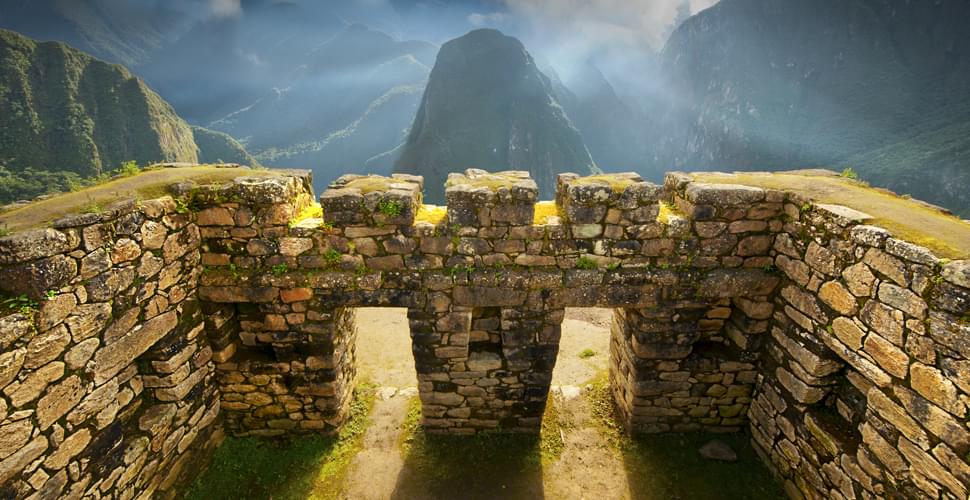
No matter how many photographs you’ve seen, stories you’ve read or posters you’ve absorbed, nothing can prepare you for the surreal whoosh of actually being at Machu Picchu. From the spot where the bus drops you, you walk up some narrow stairs and some winding paths, the sun beating on you, the sweat starting to trickle down your back, and then you reach a level area and take a few more steps and – whoosh! – suddenly there it is, spreading out before you, the gray granite walls and poky roof remains and green open lawns and jungly green rock-thrusts just beyond. Suddenly it hits you: Machu Picchu – I’ve arrived!
For a while you just stand and stare, absorbing it, letting it seep into you. Then eventually you become aware of the other travelers, some as stunned as you, and you decide it’s time to head into the ruins. And then time suspends, and you spend two, three, four – you don’t know how many – hours wandering, letting your hands trail along the rock, smelling the grass and the granite baking in the high-altitude sun. You visit the agricultural sector and the industrial zone, the temple of the three windows and the temple of the condor, the sacred square and the priests chamber, the house of the virgins of the sun, the watchman’s house, the cemetery, the temple of the sun and the sun dial. But what you are really doing is walking through time.
You’re imagining what it was like 500 years ago when a thousand people lived here – their woven clothes, the potatoes and maize they grew, the grain they stored, the granite they dragged laboriously from the quarry and the gold and silver and chisels, the wood and water, they used to break down and shape the stone. You imagine the runners arriving from Cusco, the robed priests, the weavers and warriors, singers and teachers and pottery-makers.
And then you’re imagining what it was like a century ago, when a 12-year-old boy brought a discouraged Hiram Bingham to this rocky revelation. What must it have felt like to gaze on this tumble-jumble of intricately wrought walls and plazas, trees and vines; you imagine the crescendo of emotion and astonishment, the arc of enlightenment, as Bingham gradually realized what he’d found, what he called the Lost City of the Incas.
And then you think about what this discovery set off, a succession of events every bit as tangled and dramatic as those ruins: A foreigner recognizes the significance of this remote site, clears and plunders it, and in so doing creates a global icon that is responsible for sustaining as much as 80% of the local economy today, and that has literally put Peru on the international tourist map. This eventually encourages the Peruvian government to reallocate significant resources to study and preserve other ancient sites and artifacts in the area. The ever-swelling procession of Machu Picchu-pilgrims, even as it underpins and integrates the local economy, threatens to undermine and disintegrate the site itself.
Visiting Machu Picchu is, like the site itself, multi-layered: There’s the historical backstory, the cultural backstory, and the economic backstory. And then there’s the pure human experience of being present at Machu Picchu.
It all came together for me at sunrise the following day. I arrived on the winding bus from Aguas Calientes and made my way directly to the sun dial, known as Intihuatana or “hitching post of the sun,” which sits atop a pyramid-like construct of terrace and wall in the site’s northwest quadrant. I positioned myself at the sun dial and waited, absorbing the stony stillness and the fresh scent of grass, the texture of tree. I watched the sun’s rays light the peaks behind and around me, slowly getting higher and higher, closer and closer. Minutes passed. The molecules in the air ever so slightly brightened. Then, in a suspended moment, light flared over the top of the mountain directly in front and touched the sun dial.
I was looking through the lens of my camcorder when it happened, and at the moment the sun appeared, rays shot out in six searing streaks at 45-degree angles. I felt like one streak was searing through me as well. I felt transfixed, transformed. For a suspended moment I felt drawn into the sun, enwrapped by the sun, plucked into some profound energy-stream of sun worship that coursed through the ground where I stood. This flowing energy seemed to stitch through me and through the world around me – the sun dial, the rock plazas, doorways and walls, the temples and the terraces. For a moment I felt a thoughtless understanding, a pure, empty-headed universe-connection, a solar spear-tip that pierced my heart and soul.
Then it was gone. A gaggle of giggling students clambered over the rocks, guides replayed their learned lectures, camera-wielding couples postured and posed.
But somehow, everything had been transformed.
Later that morning my guide, Manuel, joined me and we took a walk along the Inca Trail. We shared the paved path with orchids and llamas and workers who were trying to repair one section of the trail that had been weakened during the rains earlier in the year. Looking into the jungle to the right of the trail we could see more Incan walls in the thick shade. Manuel said there were probably Inca walls scattered throughout the mountains. The dense slopes seemed alive with them, echoing with the spirit of the people who tilled, ate, and slept, planted, played and prayed here 500 years ago.
As we descended into a world of luxurious blossoms and thick cloud forest shadows, I remarked that I was amazed by how well the path was paved, and Manuel told me that at its height, the Inca empire had been laced by a network of 19,000 miles of trails, virtually all paved. I stopped and touched my hand to the rough stone and tried to conjure the imagination and organization, technology and toil, required to complete such a feat. I tried to picture the worker who had placed the very stone on which I stood, whose fingers had touched the very pocks and ridges my fingertips traced. What did he eat? Where did he sleep? What did he dream?
We walked for a half hour to a point where we could see another ruin on a mountain slope – Winay Wayna, a cleared site most trekkers detour to explore. I thought of the deep-shaded walls we’d passed before – who knew what secret cities these vast jungle fastnesses still held?
The trails wound on and on, I realized, some into the cloud forest fastnesses, some into the secret cities of the soul. I remembered the stitching rays at Intihuatana, and suddenly, on this lonely, well-trod Inca trail, I felt whole.
About Don George
Utah Travel Tales - Journey to the Desert Southwest with Katie Arenas
Read More »Ryan Smith Travel Tales - Traveling Solo & Sharing Trails
Read More »See where you can go with Off the Beaten Path! Request your free journeys catalog today.
Stay in the know and feed your spirit of adventure. Get travel inspiration sent straight to your inbox!
Detailed trip information
Everything you need to know about our upcoming trips.
Adventure Collection Member
Founding member of the Adventure Collection.
What makes OBP unique
We believe travel is where the heart of the traveler meets the soul of the place.

Fill out the information below and we'll send you our current journeys catalog asap! This delightful portfolio is our annual effort to inspire travel – to remind our friends that getting out and connecting with the world enriches our lives and fills our heart and soul for a lifetime. Thanks for letting us share this with you!
An * denotes a required field
NORTH TO ALASKA
To receive our most complete detailing of this small group adventure, please provide your preferred contact information.